
The Evolving Adult Brain: Adults Are Still Becoming. How Are We Supporting Them?
Part One in An Eight-Part Series in The Thriving School Brief
The Evolving Educator is a multi-part series examining how adult cognitive development intersects with meaning-making, professional learning, and school systems design.
In the articles ahead, we will explore the difference between horizontal and vertical growth, how edge emotions and stress trigger fallback, how different developmental stages influence teaching, and how leaders can build holding environments that drive adult evolution.
Throughout the series, we return to a shared inquiry:
How might we design school systems and MTSS frameworks that align with how adults actually develop?
I live in the American West, and we are very worried about this summer.
Our way of life and our ability to thrive in this arid place depend entirely on the water cycle. If you were to look at a map of the western watershed without any borders, you would see a vast, interconnected ecosystem where water flows according to ancient, universal laws. It ignores the boundaries of counties, the lines of states, and the jurisdictions of municipalities.

Recently, the seven states that depend on this watershed failed to come to an agreement about how to manage this shared resource in a time of scarcity. The problem becomes glaringly obvious when you look at a map of state lines superimposed over the natural watershed: we are trying to manage an interconnected, organic ecosystem using artificial borders and rigid policies. But the western watershed is going to do what it does regardless of whatever regulations are put in place. The water will run the way it runs.

I find this remarkably similar to the fraught relationship between how humans actually develop and how school systems try to create change.
In my work with schools, there is a repeated mantra I hear from exhausted school leaders: "It's not the kids; it's the adults!" We impose rigid mandates, one-size-fits-all professional development, and static frameworks onto our teachers, expecting immediate behavioral shifts. We treat them like finished products who just need a software update. But just as water follows the natural laws of the water cycle, adults follow the natural laws of human development. Adults will do what they do.
To build a thriving ecosystem in our schools—like a functioning Multi-Tiered System of Supports (MTSS)—we must stop trying to manage the water with artificial borders and start understanding the water cycle itself.
The Myth of the Finished Adult
For a long time, society held a collective assumption that once we reached our early twenties, our cognitive development was essentially complete. We believed that while we might gain new facts, learn new hobbies, or accumulate more experience, the fundamental structure of our minds was set.
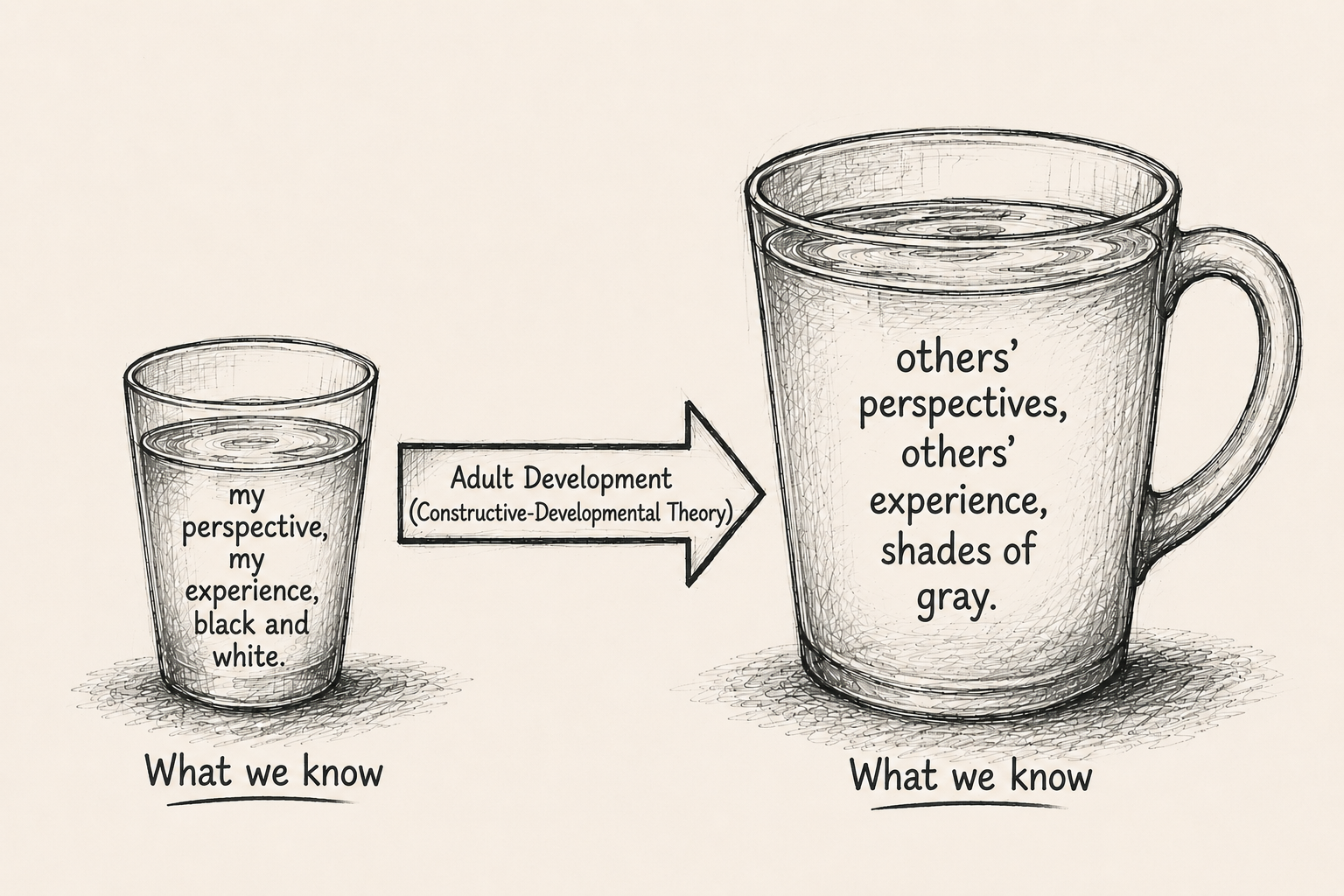
But modern developmental psychology tells a completely different story. Adults do not stop developing. In fact, if the conditions are right, we continue to evolve our "meaning-making" systems throughout our entire lives. This is the foundation of Constructive-Developmental Theory, which reveals that adult development is not just about changing what we know (adding more water to the cup); it is about transforming how we know (expanding the cup itself).
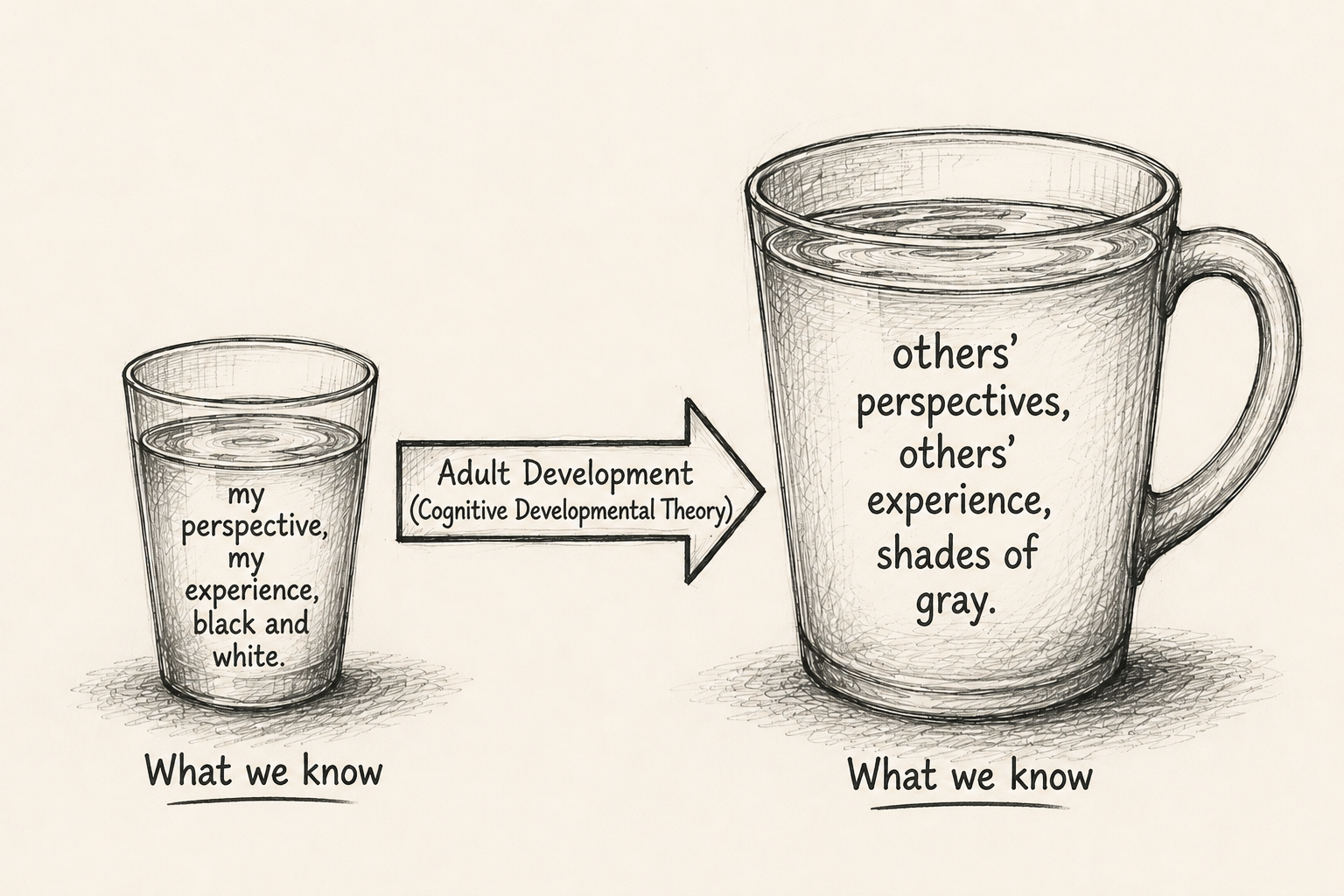
As we grow, we increase our capacity to take new perspectives, view authority in different ways, and see shades of gray where we once only saw black and white. We begin to navigate the complex, messy realities of our classrooms not by seeking a single right answer, but by developing a more sophisticated way of interpreting the world around us.
The Engine of Growth: Subject vs. Object
How exactly does this growth happen? The mechanism behind this evolution is a shift from Subject to Object. "Subject" refers to the beliefs, assumptions, and emotions we are so fused with that they completely control us. We cannot even see them because they are us. We are embedded in them. "Object," on the other hand, refers to the elements of our experience that we have gained enough distance from to reflect upon, handle, take responsibility for, and change. We grow when we move from a place where we are subject to a way of knowing, to a place where we have it as object. My professor, Robert Kegan who developed this Constructive Developmental Theory, used to refer to this as the agenda you have versus the agenda that has you.
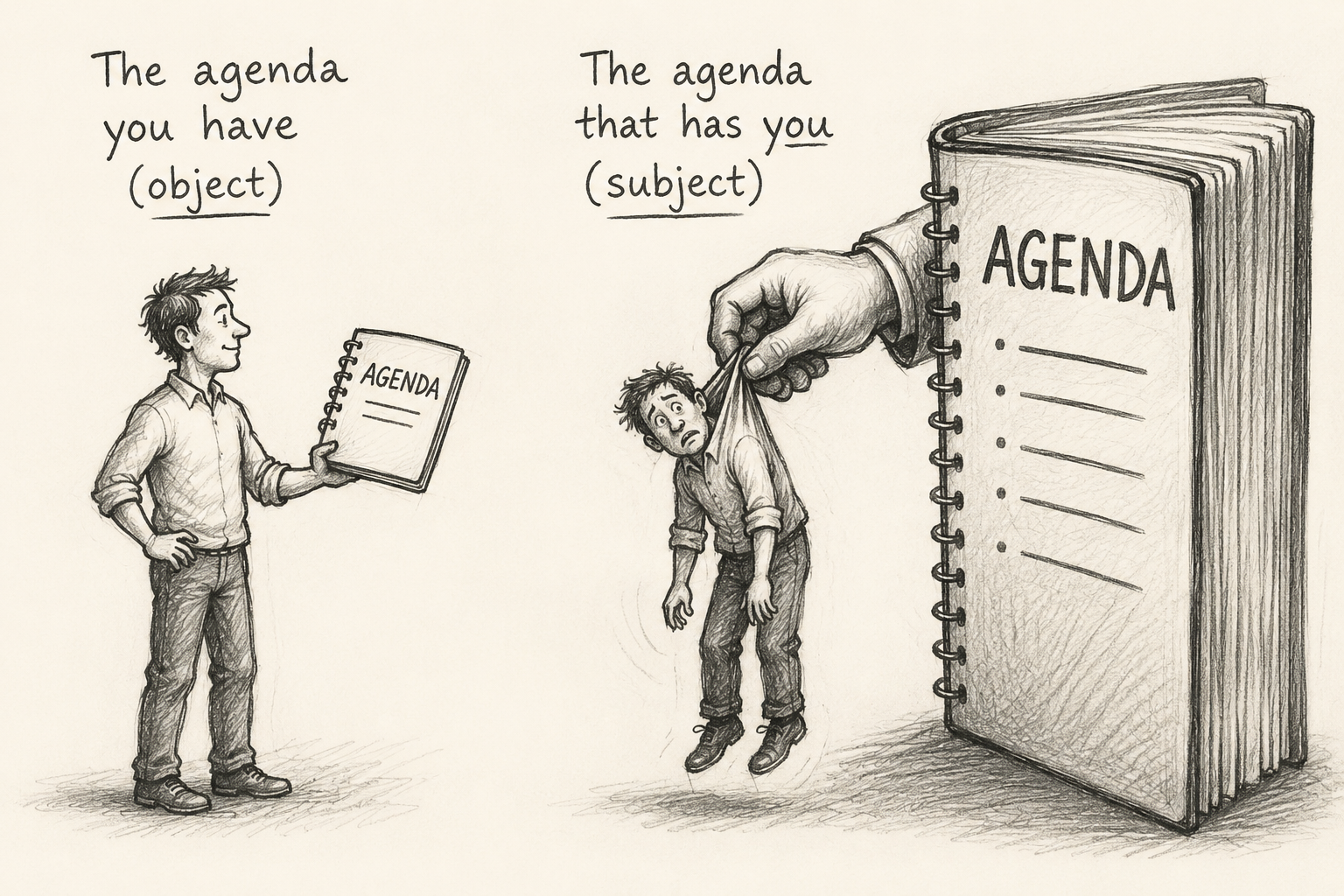
Going back to when I was a brand-new teacher, when a student rolled their eyes and talked back, I felt an immediate, overwhelming wave of anger. At that moment, I was the anger. It was Subject. It dictated my reaction, my heart rate, and the detention I likely handed out.
But as I gained experience and developmental capacity, something shifted. Years later, when my daughter rolls her eyes, I sometimes still feel anger, but I can step back from it. I can observe it, regulate it, and say to myself, "I am feeling frustrated right now, but I know her behavior is actually about calibrating her sarcasm with a trusted adult." The anger has become Object. I have the anger; the anger no longer has me.
In adult development, we grow by creating distance between ourselves and our reactions. Development and transformation occur when elements that previously controlled us (Subject) become things we can reflect on and change (Object). The more elements of our world we can hold as Object, the more complex our worldview becomes, and the more capable we are of handling the profound demands of teaching and leading in schools.
The MTSS Connection
This brings us to the heart of the matter for school leaders. When we ask our staff to implement a new MTSS—for example, asking them to shift from a punitive discipline mindset to a restorative mindset—we are not just asking for a change in behavior. We are demanding a profound developmental shift.
We are asking teachers to take their deeply held beliefs about fairness, punishment, and authority (things they are currently "Subject" to) and make them "Object" so they can examine and alter them. This is heavy, cognitive lifting. And a teacher's ability to meet this demand depends entirely on where they are in their own developmental water cycle.
To illustrate this, let’s look at a very specific expectation: Asking teachers to implement a new restorative conferencing protocol in your MTSS framework instead of immediately sending students out of the room.
Let's walk into the staff room and see how three different teachers, operating from three different adult developmental stages, might respond based on what they are "Subject" to and what they hold as "Object."
The Socialized Educator: "Sandy.”
Sandy is in her fourth year of teaching. She is warm, deeply empathetic, and beloved by her students. She spends her own money on classroom supplies and is always the first to volunteer for the prom committee. Sandy is currently making meaning from what is known as the Socialized Mind. At this stage, adults have developed the ability to subordinate their own immediate impulses and be guided by the norms, standards, and expectations of the systems they belong to: their family, their school culture, or their peers.
What Sandy holds as Object: Her own immediate needs and impulses. She can easily put her own desires aside for the good of her students or her team.
What Sandy is Subject to: The expectations of her peers, the school culture, and external validation. Other people are experienced as her primary source of internal authority. She relies on the veteran teachers, her principal, her friend group to help her know what the "right" answer is.
Her Response to the Restorative MTSS Mandate: When the principal announces the new restorative conferencing protocol, Sandy takes careful notes. She wants to do it right. But during lunch, she sits in the staff lounge and listens to three veteran teachers loudly complain that the new protocol is "soft on consequences" and "lets kids off the hook."
Sandy suddenly feels paralyzed. She is deeply invested in being a "good teacher" in the eyes of her principal, but she is equally invested in being accepted by her peers. Because she is Subject to the approval of others, she cannot simply adopt the new mandate without feeling like she is betraying her team. She feels torn apart by the conflict between the important people in her environment. If she holds a restorative circle, she fears the veteran teachers will judge her. If she writes a referral, she fears the principal will judge her.
How to Support Sandy: Traditional PD that simply hands Sandy a binder of restorative scripts will fail her. Sandy doesn't just need instructions; she needs a leader to provide a highly supportive "holding environment". Leaders can support Socialized educators by offering clear, concrete protocols so they know exactly what the "right" action looks like, while simultaneously offering deep affirmation of their hard work. Sandy needs her principal to validate her effort and help her navigate the staff lounge dynamics, essentially serving as a stronger, more supportive voice until she can develop her own.
The Self-Authoring Educator: "Marcus"
Marcus has been teaching 10th-grade history for twelve years. He is respected, highly competent, and known for running a tight ship. His classroom is orderly, his expectations are crystal clear, and he holds students to a high standard. Marcus operates from the Self-Authoring Mind. At this stage, adults no longer feel torn apart by the conflicting expectations of others because they have developed their own internal value system. They have their own compass. They can step back from the culture of the school and generate their own ideology and principles.
What Marcus holds as Object: The expectations and opinions of others. He can hear the complaints in the staff lounge, reflect on them, and decide for himself if he agrees. He does not need external validation to know he is a good teacher.
What Marcus is Subject to: His own self-authored ideology, his teaching philosophy, and his internal value system. He is embedded in his own standards.
His Response to the Restorative MTSS Mandate: When the principal announces the restorative conferencing mandate, Marcus listens, but he does not immediately comply. He evaluates the new protocol against his own internal compass. Marcus strongly believes that the best way to prepare students for the harsh realities of the real world is to teach them that actions have immediate, concrete consequences. His self-authored ideology tells him that restorative circles lack accountability. Marcus will not adopt the protocol just because the principal told him to, nor will he reject it just because the staff lounge is grumbling. He pushes back in the staff meeting, articulating a well-reasoned argument against the policy. If forced to comply, he will do so begrudgingly, seeing it as an administrative hurdle that interferes with his "real" work of teaching. He is not being difficult for the sake of being difficult; he is fiercely protecting the internal values he believes best serve his students.
How to Support Marcus: You cannot manage a Self-Authoring teacher with top-down compliance. Mandates will only cause them to dig their heels in deeper. To engage Marcus, school leaders must respect his autonomy and engage his intellect. A leader must invite Marcus into a dialogue about why the MTSS framework exists. If a leader can help Marcus see how restorative practices actually align with his own deeply held goals for student success—perhaps by showing him data on how exclusionary discipline negatively impacts long-term graduation rates—Marcus will evaluate the evidence. If he decides the new way serves his overarching mission better, he will become an independent, self-driven champion of the work.
The Self-Transforming Educator: "Elena"
Elena is the Science Department Chair and has been teaching for twenty years. She is the teacher everyone goes to when a student is having a meltdown. She has an uncanny ability to de-escalate situations and seems entirely unbothered by the chaos of high school hallways. Elena operates from the exceedingly rare Self-Transforming Mind. At this stage, adults recognize that any single framework or philosophy—even their own carefully constructed one—is inherently incomplete. They see the world as a complex, interconnected system. They don't just tolerate ambiguity; they lean into it and generate it.
What Elena holds as Object: Her own ideology and identity. She can step back from her own deeply held beliefs and examine them for blind spots.
What Elena is Subject to: The dialectic process of meaning-making itself; the ongoing evolution of interconnected systems.
Her Response to the Restorative MTSS Mandate: Elena is entirely untroubled by the complexity of the new MTSS mandate. In fact, she embraces the paradoxes it creates. When she reads the protocol, she sees its immense value for building relational trust with students. However, she also actively listens to Marcus’s pushback during the staff meeting and recognizes the absolute validity of his concerns regarding accountability. Instead of picking a side between "restorative" and "punitive," Elena sees how both perspectives are necessary to create a whole system. She understands that true restorative justice requires high accountability. She doesn't view the new protocol as a finished product to be blindly followed; she views it as a starting point. She immediately begins experimenting with the protocol in her classroom, tweaking it, gathering feedback from her students, and looking for ways to improve it.
How to Support Elena: A school leader doesn't need to "manage" Elena; they need to utilize her as a thinking partner. Elena thrives when she is given the space to co-create and adapt frameworks dynamically. Leaders should invite her to help design the implementation rollout, asking her to facilitate spaces where the colliding perspectives of the staff can be safely explored. Because she can see connections everywhere and does not feel threatened by disagreement, she can help bridge the gap between teachers like Sandy and teachers like Marcus.
Building the Holding Environment
Returning to our watershed metaphor, we cannot force the water to flow uphill, and we cannot force a teacher to instantly adopt a new order of mind. Human development requires time, struggle, and the right environment to unfold. If we want our teachers to navigate the incredible complexities of modern education, we must build systems that support where they are right now, while gently challenging them to grow toward where they need to be.
This is called creating a "Holding Environment"—a culture that provides an ingenious blend of high support and high challenge.
When we give teachers "One-Size-Fits-All" professional development, we are ignoring the reality of the ecosystem. We are trying to hand Marcus a script when he needs a philosophical debate. We are giving Sandy autonomy when she desperately needs structural clarity and affirmation.
Our school systems will transform when we recognize that a functioning MTSS is ultimately a massive, collective meaning-making exercise. We cannot cultivate self-awareness, self-management, and social efficacy in our students if we are not actively cultivating them in our educators. It is the job of the school leader to design for the the watershed that exists, to create the collaborative teams, the psychological safety, and the differentiated professional learning that allows the adults in the building to evolve. Because when the adults grow, the students thrive.
What to Expect From This Series
If our broader school systems are like a massive western watershed, you, as a school leader, are the steward of your own specific branch of the river. You may not be able to control the artificial state lines, the standardized testing mandates, or the policies that flow down from the top, but you have immense power over your local ecosystem.
Your role is to build this "holding environment,” a local culture that provides the exact right blend of high support and high challenge necessary for the adults in your building to evolve. Over the next seven articles, we are going to map out exactly how to build that environment in your corner of the watershed.
Here is where we are heading in The Evolving Educator series:
Part 2: Two Paths of Growth (Horizontal vs. Vertical Development) We will explore the crucial difference between adding new skills (filling the cup) and upgrading a teacher's entire operating system (growing the cup). You will learn why your drowning new teachers need something entirely different from your veteran teachers to stay engaged.
Part 3: The Socialized Educator We will dive deeper into teachers like "Sandy" who are driven by a need to belong and rely heavily on the expectations of their peers. We will discuss how to create holding environments that validate their hard work and relational strengths while gently encouraging them to develop their own internal compass.
Part 4: The Self-Authoring Educator We will look at teachers like "Marcus" who have already developed a strong, independent ideology. You will learn how to harness their autonomy and invite them to co-create systemic change, rather than triggering their resistance through top-down compliance.
Part 5: The Heat of Transformation Growth requires friction. We will discuss how to safely guide your staff through "disorienting dilemmas"—those profoundly uncomfortable moments when a teacher's old methods stop working, edge emotions flare up, and new capacities must be constructed to survive.
Part 6: Edge Emotions and the Reality of Fallback What happens when exhausted educators revert to old, rigid habits under stress? We will unpack the reality of "fallback"—the temporary loss of our highest developmental capacities—and how you can design structural safety nets when your staff’s capacity is running low.
Part 7: Differentiating Professional Learning (MTSS for Adults) If we differentiate instruction and interventions for our students, why do we give our teachers "one-size-fits-all" professional development? We will translate these developmental theories into practice by exploring what Tier 1, Tier 2, and Tier 3 supports actually look like for the adults in your building.
Part 8: Tying It All Together: The Deliberately Developmental School Finally, we will synthesize these concepts into a practical blueprint for a "Deliberately Developmental Organization". We will look at how you can weave adult growth into the daily, moment-to-moment fabric of your school’s culture, creating a thriving, self-sustaining branch of the watershed where both adults and students flourish.
The western watershed is going to do what it does, and adults are going to grow the way they grow. I look forward to navigating these waters with you over the coming weeks as we learn to design schools that honor both.
