
Two Paths of Adult Growth: Horizontal vs. Vertical Development
Part Two in An Eight-Part Series in The Thriving School Brief
The Evolving Educator is a multi-part series examining how adult cognitive development intersects with meaning-making, professional learning, and school systems design.
In the articles ahead, we will explore the difference between horizontal and vertical growth, how edge emotions and stress trigger fallback, how different developmental stages influence teaching, and how leaders can build holding environments that drive adult evolution.
Throughout the series, we return to a shared essential question:
How might we design school systems and MTSS frameworks that align with how adults actually develop?
A Tale of Two Teachers
My first year as an assistant principal, I remember arriving home at eight o'clock on a freezing February evening, utterly exhausted, realizing that I was working tremendously hard but effecting little change. As the primary disciplinarian, I spent my days dealing with an overwhelming volume of office referrals. My default response was to rely on the district's code of conduct, which often resulted in handing out suspensions for students stuck being sent out of the same teachers' classes repeatedly.
It did not take long for me to realize that my approach was failing. I was frequently suspending students because we were providing a poor classroom experience, but my school lacked a system to give teachers the feedback and support they actually needed. I was trapped in a cycle of reactive discipline, trying to fix a deeply rooted cultural problem with a punitive rulebook.
This realization brought me face-to-face with the reality of adult development and the wildly varying needs of the teachers in my building. Two teachers, in particular, perfectly illustrated this challenge, Ginger and Mason.
Ginger was previously a teacher in a suburban school in the Eastern US who had relocated and joined our staff. From the moment she stepped into our diverse, urban environment, she was shocked daily by the realities of her new setting. She had little interest or capacity at the time to meet the students where they were, and she gave up on them easily. As a result, her classroom rapidly deteriorated into chaos. As the disciplinarian, I was tasked with addressing the students' unwanted behavior, but it was clear that Ginger needed as much intervention and support as the kids did. She was in a state of professional survival.
Down the hall was Mason. Mason had been teaching at the school for five years. While he had struggled to engage students early in his career, he was incredibly receptive to feedback and had proactively reached out to other teachers to observe their practices. Over time, his classroom management had improved tenfold. His deep passion for history translated into a desire to expand his instructional repertoire far beyond traditional notes and movies, and he had recently begun experimenting with student-driven projects. Mason was undeniably a "teacher on the rise." Yet, despite his potential, he was stagnating because he was not getting the administrative support and intellectual challenge he needed to grow more quickly.
The Trap of "One-Size-Fits-All" Professional Development
As a school leader, observing Ginger and Mason forced me to confront a massive systemic failure in how we handle teacher growth. In a traditional school model, when August rolls around, we put Ginger, Mason, and the rest of the faculty into the same cafeteria or library. We hand them the same binder, present the same slide deck on our new Multi-Tiered System of Supports (MTSS), and expect them to implement the same strategies with the same level of fidelity.
But throwing a standard, one-size-fits-all Professional Development session at these two teachers will fail both of them spectacularly. To understand why, we must fundamentally shift our lens as leaders and stop viewing all professional struggles as a lack of knowledge.
Fundamental 1: Technical Solutions vs. Adaptive Challenges
When a teacher is struggling to manage a classroom or implement a new school-wide initiative, a leader's default response is often to send them to a workshop or create a new professional development session. This approach assumes the teacher is facing what leadership researchers Ronald Heifetz and Marty Linsky call a technical challenge.
Technical challenges are problems with known solutions that can be fixed with current expertise. Think of a broken arm: you go to a doctor, they apply a cast, and the arm heals. The problem is clear, the solution is known, and the fix can be applied externally. In schools, if a teacher lacks a specific pedagogical tool, they have a "skill gap." This is a technical challenge.
Adaptive challenges are entirely different. They are not easily fixed because the people experiencing the problem do not currently possess the knowledge or mindset to fix it. Think of an adaptive challenge like being diagnosed with a chronic illness; a doctor cannot simply "fix" it with a cast. Managing it requires the patient to learn entirely new ways of living, to change their daily habits, and to potentially let go of deeply held values.
When we ask our staff to implement an equitable MTSS framework, to shift from punitive to restorative discipline, or to navigate systemic inequities, we are asking them to solve adaptive challenges. Adaptive challenges cannot be solved by simply downloading new information; they require individuals to shift their perspectives and let go of deeply held beliefs. When a teacher cannot meet these adaptive demands, they are not suffering from a skill gap; they are experiencing a "capacity gap." They lack the underlying developmental infrastructure to make sense of the complexity required by the task.
Two Paths of Growth: The Metaphor of the Cup
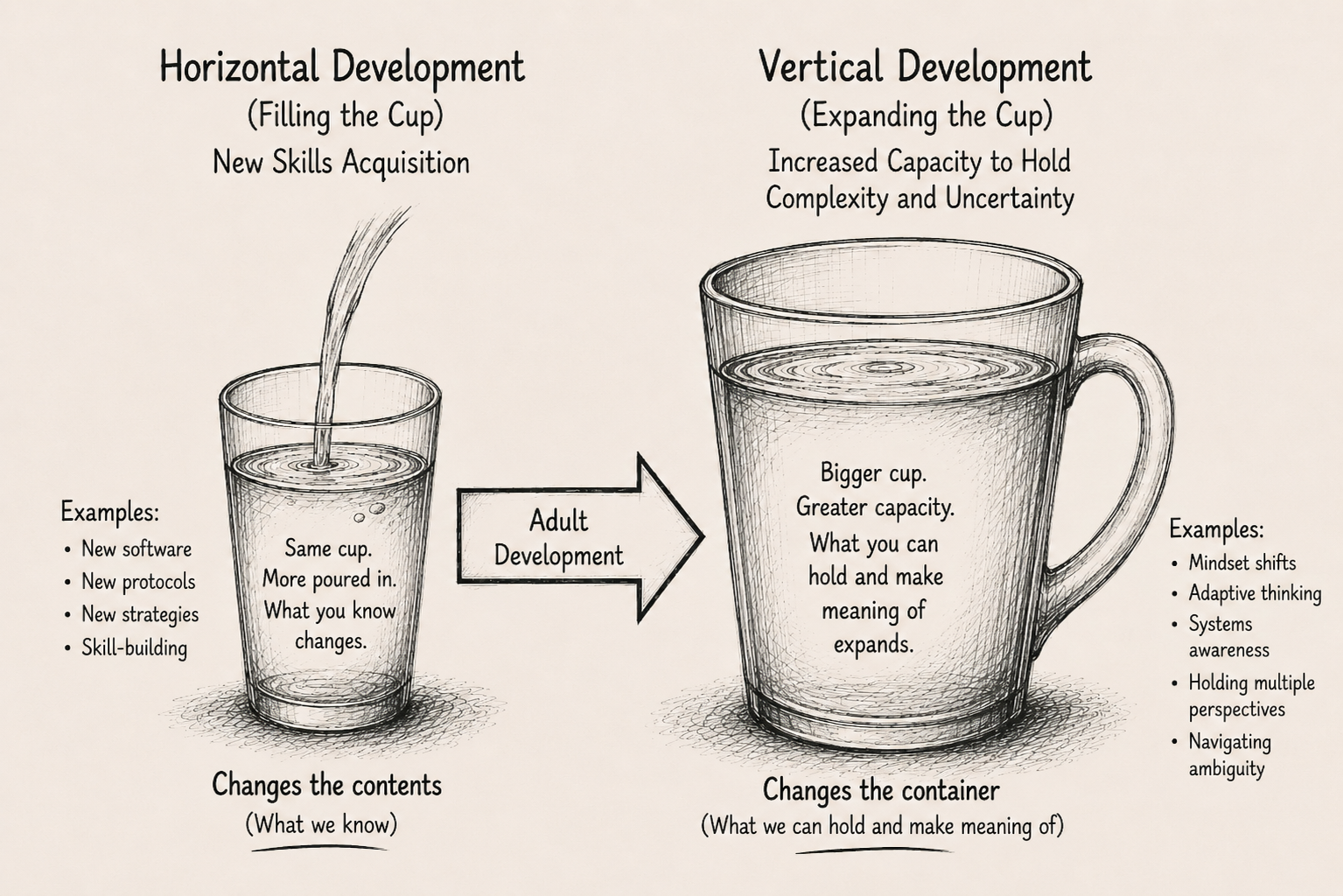
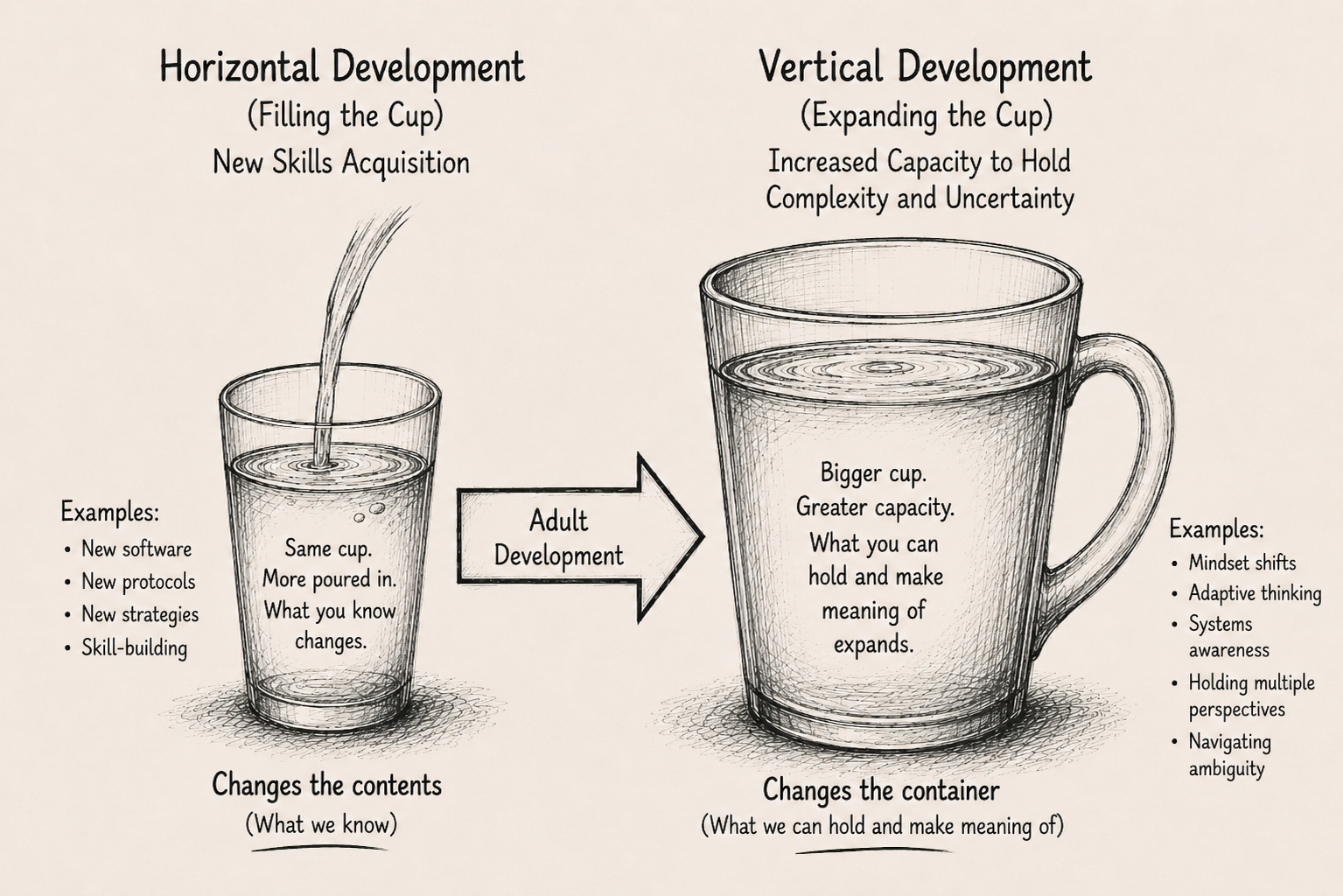
To put this into practical terms, let's return to the metaphor we introduced in our first article. Drawing on Robert Kegan’s work, we discussed the difference between adding more water to the cup and expanding the cup itself. Leadership researcher Nick Petrie builds directly on Kegan’s foundational work, giving us a practical vocabulary for these two distinct paths of growth: Horizontal and Vertical development.
Horizontal Development (Filling the Cup) Horizontal development refers to the acquisition of new information, skills, and competencies. If your mind is a cup, horizontal development is the process of pouring more water into it. It is about increasing what you know. Traditional professional development excels here. When we teach an educator how to use a new grading software or how to follow a behavioral referral protocol, we are engaging in horizontal development. It is the perfect response to a technical challenge or a skill gap.
Vertical Development (Expanding the Cup) Vertical development, on the other hand, is the cultivation of more complex and sophisticated ways of thinking. As Kegan notes, it is not about changing the contents of the mind; it is about changing the actual container. Vertical development expands the cup itself, increasing an adult’s capacity to hold more complexity, uncertainty, and multiple perspectives without overflowing. It involves a fundamental shift in how you make meaning of your experiences, allowing adults to perceive shades of gray where they once saw only black and white. It is the necessary path for solving adaptive challenges and closing capacity gaps.
Ginger’s Need: A Horizontal Lifeline
Let’s return to Ginger. As a school leader, if you do not understand the difference between technical and adaptive challenges—or between horizontal and vertical development—you might look at Ginger’s chaotic classroom and decide she needs to understand the "root causes" of student behavior. You might send her to a multi-day seminar on dismantling systemic racism, or ask her to lead a complex, peer-mediated restorative justice circle.
If you do this, Ginger will fail, and she will likely leave the profession.
Why? Because Ginger is currently drowning. Her cup is completely overflowing. She is in a state of daily crisis, overwhelmed by the immediate demands of her new urban environment. When a teacher’s cognitive and emotional load is maxed out, they do not have the bandwidth for vertical expansion. They do not need a philosophical debate about systemic inequities; they desperately need a technical, horizontal lifeline.
Ginger needs leaders to provide concrete, bite-sized horizontal skills to help her survive and stabilize her environment. She needs foundational, Tier 1 MTSS classroom practices that she can implement tomorrow morning. For example, a leader supporting Ginger should focus intensely on helping her master a technical "Meet and Greet" routine at the classroom door to establish positive personal relationships and set the tone for the class period. She needs coaching on how to deliver "Clear Instructions" so her students know exactly what is expected of them. She needs to learn how to utilize "Visual Postings"—like agendas and expected classroom procedures—to organize her learning environment, reduce student anxiety, and minimize disruptions.
By providing Ginger with these highly structured, technical horizontal skills, you are helping her empty some of the water out of her overflowing cup. You are giving her immediate, achievable wins that will rebuild her confidence. Only after her environment is stabilized, and her cup is no longer overflowing, can you begin to gently introduce adaptive challenges that ask her to expand her cup to better understand students from different backgrounds and how to meet them where they are.
Mason’s Need: Vertical Expansion
Now let’s look at Mason. Mason has been teaching for five years and runs a tight ship. His classroom management and relationships with students are excellent, and he is highly competent.
If you force Mason to sit through the same horizontal professional development session on "How to Write a Hall Pass" or "The Five Steps of a Meet and Greet," you will bore him to tears. His cup is already full of foundational teaching skills. He has mastered the horizontal domain of basic, technical classroom management.
Mason is hungry for something deeper. He is actively seeking feedback to try out complex, student-driven projects, but he is stagnating because the system is treating him like a novice who just needs more technical "tips and tricks". Mason desperately needs vertical development. He needs an adaptive challenge to expand his cup.
But how do we actually facilitate vertical growth? If horizontal development happens through "information transfer" and "skill practice," how do we help a teacher upgrade their entire operating system?
According to Nick Petrie, optimal vertical development requires three specific conditions to be present simultaneously: Heat Experiences, Colliding Perspectives, and Elevated Sensemaking.
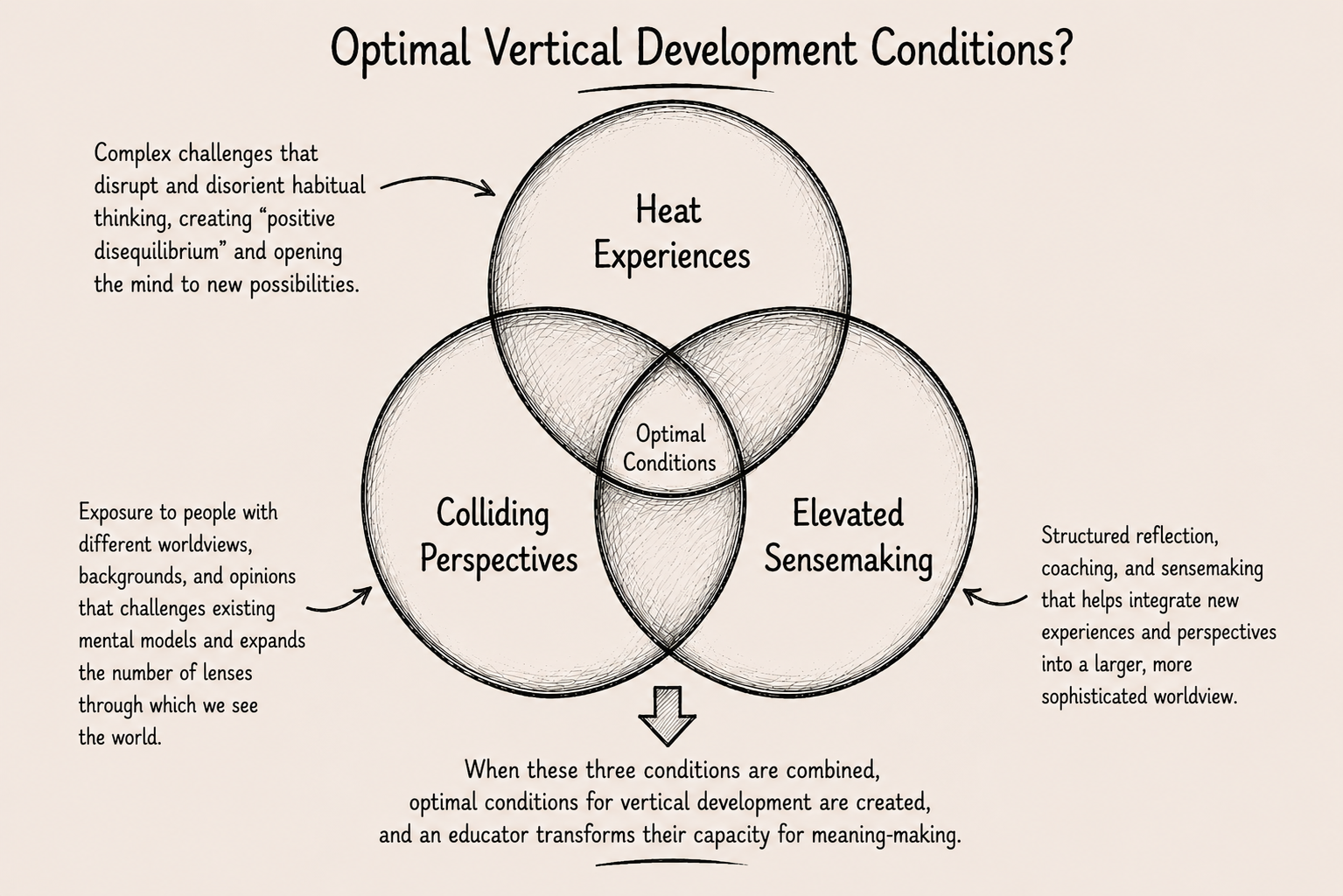
1. Heat Experiences Heat experiences occur when an adult learner faces a complex situation that disrupts and disorients their habitual ways of thinking. The individual discovers that their current meaning-making system is entirely inadequate for the challenge in front of them. This creates "positive disequilibrium," forcing the mind to open up and search for new, better ways to understand reality. Mason needs a heat experience. Mason needs an adaptive challenge aligned with his interest in student-driven projects. Instead of letting him safely experiment in isolation, a leader could task him with designing a complex, cross-curricular exhibition that forces him out of his single-subject classroom and requires him to navigate the messy reality of community partnerships and overlapping academic standards.
2. Colliding Perspectives Growth cannot happen in an echo chamber. When individuals encounter people with fundamentally different worldviews, backgrounds, and opinions, their existing mental models are challenged. This collision of perspectives increases the number of lenses through which a person can view the world. If Mason faces a "heat experience" without exposure to diverse perspectives, he will simply fall back into his habitual thinking patterns and arrive at the same conclusions he always has. A school leader must intentionally place Mason in collaborative, interdisciplinary teams where he has to negotiate pedagogical disagreements with peers who think very differently than he does.
3. Elevated Sensemaking Finally, heat and colliding perspectives alone are not enough; in fact, without support, they can simply lead to burnout or cynicism. The third condition involves using structured processes or coaching relationships to help the individual integrate their new experiences and perspectives. A larger, more sophisticated worldview emerges through deliberate reflection and sensemaking. Mason needs an instructional leader to serve as a thinking partner, someone who will sit down with him after a failed student-driven project, not to give him a technical checklist of what he did wrong, but to help him reflect on how he is thinking about student autonomy and why his current mental framework might be limiting his success.
When these three conditions—Heat, Colliding Perspectives, and Elevated Sensemaking—are combined, optimal conditions for vertical development are created, and an educator transforms their capacity for meaning-making.
The MTSS Connection: Differentiating for Adults
This brings us back to the overarching goal of building a thriving Multi-Tiered System of Supports (MTSS) in our schools. In education, we have largely accepted the premise that students require a tiered system of support based on their diverse academic, social, and emotional needs. We understand that Tier 1 promotion and prevention strategies are necessary for all students, while Tier 2 and Tier 3 interventions are required for students experiencing persistent struggles.
Yet, when it comes to the adults in the building, we completely abandon this logic. We expect a single, unified professional development plan to magically transform the practice of every teacher, regardless of their developmental readiness.
If school leaders want teachers to successfully implement a complex MTSS framework—which requires shifting from a punitive mindset to a restorative one, navigating systemic biases, and facilitating nuanced academic interventions—they must begin differentiating their leadership and support.
We must learn to diagnose our staff. We have to ask ourselves hard questions:
Are we throwing intense vertical "heat experiences" at overwhelmed novices who are drowning and desperately need a horizontal lifeline of basic, technical skills?
Are we handing out horizontal, compliance-driven checklists to our most competent, veteran practitioners who are bored, stagnating, and desperately need to be pushed to excel through vertical, adaptive challenges?
A school system cannot solve adaptive problems with technical solutions. If you want our teachers to build a cohesive, responsive MTSS ecosystem for students, we must first build a differentiated, developmentally aligned ecosystem for the adults.
Looking Ahead: Building the Holding Environment
Understanding the difference between horizontal and vertical development—between filling the cup and expanding the cup—is the first fundamental step in rethinking how we lead schools. But diagnosing the gap is only half the battle. Once we know what a teacher needs, how do we actually provide the right balance of support and challenge?
In adult developmental psychology, this is called building a "holding environment". Over the coming weeks, we will explore exactly how to construct these environments for the diversity of adult learners in your school.
In our next article, we will dive deeply into the specific psychological reality of the educator who is driven primarily by a need to belong and the expectations of their peers, the "Socialized Educator." These are our new teachers who want to do the right thing, want to learn, and are looking to the culture, veteran teachers, and school leaders to guide them. Often our holding environments do support these teachers and understanding their unique needs will support your plan to differentiate for your myriad of adult learners.
