
The Plastic Brain: Why Experience Can Change Everything
Part Seven in An Eight-Part Series in The Thriving School Brief
About This Series
Inside the Adolescent Mind is a multi-part series examining how adolescent brain development intersects with identity, learning, and school design.
In the articles ahead, we will explore how emotions shape behavior, how sleep and stress affect cognition, how belonging influences decision-making, and how experience drives growth across adolescence.
Throughout the series, we return to a shared inquiry:
How might we design school systems that align with how adolescents actually develop?
Ali was fifteen years old when she joined in my advisory mid-year. She had been “asked to leave” her previous school, and her file arrived thick with behavioral notes. She lived with her single dad; her mother had died when Ali was young.
From the moment she started at our school, she was struggling in all of her courses. Her baseline was extreme disruption and argumentativeness. She pushed back against nearly every expectation, creating daily, escalating issues for teachers and other learners. It culminated when one of her teachers reached a breaking point and asked that Ali no longer attend her class.
As her advisor, I was at a complete loss for what to do. Feeling defeated, I went to my principal for support. Our meeting consisted entirely of me listing all of Ali's shortcomings, her disruptions, her missing assignments, and the sheer exhaustion of trying to manage her presence in the building.
My principal listened patiently, let me finish, and then stopped me cold.
She said simply: "You have told me what Ali is bad at. What is she good at?"
I could not answer her. I realized, with a heavy dose of professional humility, that I had no idea. I only knew her through the lens of her deficits.
That single question forced a pivot. I set up a meeting with Ali and her dad with one primary agenda item: finding out what she was good at and interested in. During that conversation, she shared that she had an interest in fashion and really wanted to learn how to sew. Incidentally, I knew how to sew.
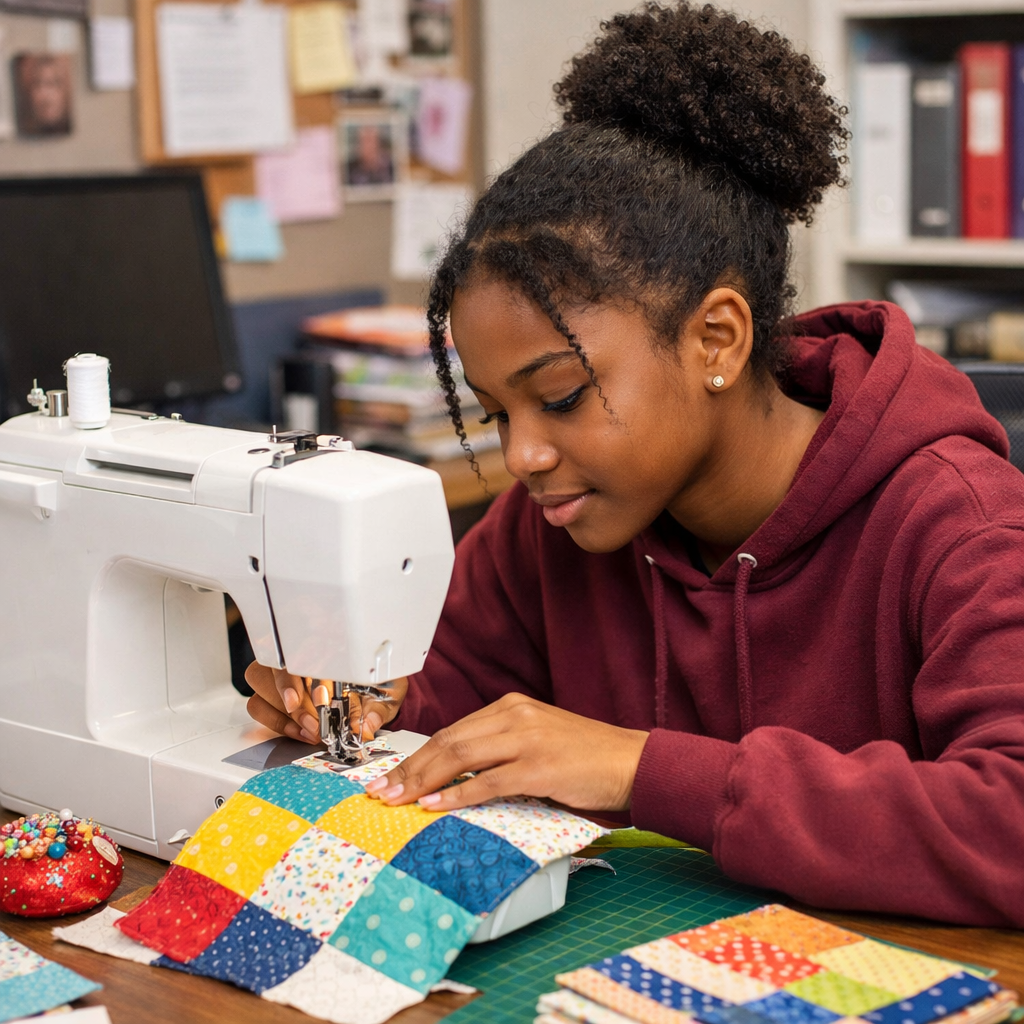
We made an unconventional plan. For one month, during my planning period, we flexed Ali's schedule. Instead of sitting in a study hall or a class she was failing, she came to a small shared office space. She designed and sewed blocks for a quilt. After some brief lessons in using a sewing machine, I was able to work on my lesson planning as we chatted. When she got stuck on a stitch or a design element, I answered her questions and helped her troubleshoot.
I could not keep this up forever, of course. My planning period was precious, and she needed to be in her core classes. But that one month fundamentally changed Ali's experience at our school. By flexing her schedule for a short while to pursue a genuine interest, she shifted. She saw adults actively trying to meet her halfway. She experienced a space where she was competent, connected, and safe.
She became notably less argumentative. She successfully returned to the class she had been asked to leave. She began to go with the flow and no longer felt the visceral need to fight everything and everyone. This is not to say a magic wand was waved—she did not completely stop being disruptive or loud at inappropriate times. But she did it far less frequently, and when corrected, she was much more open to feedback.
You might be thinking, “I would never give up my planning period to do this.” I understand that. But that one-month sacrifice effectively ended a cycle of daily disruptions, office referrals, and teacher burnout that would have otherwise consumed our time for the rest of the school year.
When we look at Ali's shift, it's tempting to ask, 'Why did sewing fix her behavior?'
But a developmental lens reveals the real takeaway: There was always more capacity there than we were seeing. Sometimes, providing the right experience requires a heavy, short-term investment, but it changes the student's trajectory and ultimately saves the system.
When we see these flashes of unexpected growth, it invites a powerful shift in how we approach vulnerable students. The question shifts from, “Why is this student like this?” to a much more profound question: “What experiences are shaping what this student is becoming?”
The Big Idea: Neuroplasticity in Adolescence
The adolescent brain is not fixed. It is shaped, continuously and fundamentally, by repeated experience.
This is the power of neuroplasticity. Neural pathways strengthen with use, and unused pathways weaken. Experience is the primary driver of this physical change in the brain. It means that what adolescents do, what they feel, and how they interact with their environment literally wires their developing brain architecture.
We often think of school as a place where students go to receive an education. But from a neurological perspective, school is an environment of repeated experiences that shapes the student.
Experience is not just something students have. It is something that shapes them.
What Is Physically Happening in the Plastic Brain
At a physiological level, the brain is highly adaptive. Repeated experiences strengthen neural pathways, making those specific responses faster and more automatic, a process we discussed at length in our article on the myelinating brain.
But neuroplasticity adds another critical layer: emotionally charged experiences wire faster. The brain is uniquely sensitive during adolescence, a period of rapid growth and vulnerability. The brain is always learning and adapting to its environment, even when we are not intentionally teaching. It adapts to what is repeated, not what is intended.
If a student repeatedly experiences humiliation or chronic failure in the classroom, the brain wires for defense. The amygdala becomes hyper-vigilant to social threat. If students repeatedly experience safety, success, and connection, as Ali did during those quiet planning periods, the brain wires for regulation and trust.
Moving Beyond Adversity: Introducing the HOPE Framework
For years, the conversation around vulnerable students has rightly focused on trauma and ACEs (Adverse Childhood Experiences). The 1998 ACEs study conclusively showed how childhood adversity can disrupt the architecture of the developing brain and lead to long-term health and behavioral challenges.
Ali had a high ACE score. She had lost her mother at a young age, lived in a single-parent household that was undoubtedly navigating grief and stress, and had experienced the trauma of being removed from her previous school. If we only looked at her through the lens of her adversity, her explosive behavior made perfect sense.
But ACEs and toxic stress represent only one half of the developmental story.
To fully harness the plastic brain, we must introduce a complementary framework: HOPE (Health Outcomes from Positive Experiences), developed by researchers at Tufts Medical Center.
The core premise of the HOPE framework is that positive childhood experiences (PCEs) actively build resilience and can actually mitigate the neurological impacts of toxic stress. The framework identifies four specific "building blocks" of positive experience that all youth need to thrive:
Safe and Supportive Relationships: Beyond just their immediate family, adolescents desperately need adults who genuinely care about them, hold them to high expectations, and help them feel like they matter. “I am on your case, but on your side.”
Safe, Stable, and Equitable Environments: This encompasses physical safety, but also emotional predictability. It means learning in spaces where a student's dignity is protected and adults actively support co-regulation of big emotions.
Social and Civic Engagement: Students need to feel a genuine sense of connectedness and belonging that extends beyond their relationships with individual adults. The culture of the school–the way “we do things here”–must be designed so that students believe, first and foremost, “I belong in this academic community.”
Emotional Growth: Adolescents need spaces to practice identifying their feelings and navigating conflict. Because these competencies are cultivated through practice, classrooms must intentionally identify and support the durable skills that lead to success. This means offering students opportunities to practice these skills while they are regulated, and ensuring adults are equipped to help dysregulated students understand their emotions and successfully rebound.
It is not only adversity that shapes the brain. Positive experience builds it, too.
How HOPE Rewires the Brain
When we apply the HOPE framework to Ali's story, the neurological shift becomes clear. We did not erase her trauma. We did not erase the loss of her mother. We did not magically teach her all the academic skills she was missing.
Instead, we provided a dense dosage of positive experience. By giving her a safe environment, a supportive adult relationship, an engaging task tied to her identity, and a space to regulate emotionally, we gave her plastic brain a new set of inputs.
Her brain, which had been highly wired for threat detection and argumentativeness, was given the opportunity to practice safety. Because of neuroplasticity, that repeated practice of safety literally began to strengthen different neural pathways. The biological stress response was mitigated. This is why she could return to the class she was asked to leave and be more open to feedback. She had borrowed my regulation, built her own, and generalized it to the rest of her day.
The Pattern Across the Series: Coherence
If we look back across this entire Adolescent Development series, a deeply cohesive picture of the brain emerges. None of these developmental processes operate in isolation. They are intertwined in every secondary school hallway and classroom.
The Pruning Brain: During adolescence, the brain determines what matters enough to keep. When we provided Ali with a sewing project, we gave her brain an interest and an identity to prune toward, rather than just pruning away the parts of herself that didn't fit the traditional school mold.
The Myelinating Brain: The brain determines which responses become efficient and automatic through repetition. Ali had heavily myelinated her pathways for argumentativeness and disruption. By changing her schedule, we interrupted that practice loop and allowed her to myelinate pathways for calm focus and connection.
The Integrating Brain: Adolescence is a time of bringing different, chaotic parts of the self into coherence. Ali was struggling to integrate her grief, her academic frustration, and her emerging identity. The relational safety of our unstructured chats helped her link her emotions with language and understanding.
The Emotional Brain: The limbic system activates fast, driving adolescents to feel before they think. Ali’s explosive behavior was a sign of an overwhelmed emotional brain. Our intervention lowered the social threat, allowing her prefrontal cortex to come back online.
The Tired Brain: We know that exhausted, dysregulated nervous systems have a remarkably thin margin for impulse control. While I didn't know her exact sleep schedule, the trauma of her past undoubtedly kept her nervous system on high alert.
The Social Brain: Adolescents are highly attuned to peer audiences and status. By pulling Ali out of the public arena where she had to constantly perform her toughness to protect her dignity, we removed the audience effect and allowed her to de-escalate privately.
The Plastic Brain: This is the final key. All of the above is shaped through experience.
Repetition wires the system. Experience selects what sticks.
The Plastic Brain and MTSS Alignment
This science demands a massive shift from simple insight to intentional system design. Schools are not just places of instruction; they are ecosystems of repeated emotional and social experiences. Therefore, schools are actively shaping student brains every day.
If we do not design our systems intentionally, we run a massive risk. In unmanaged or highly punitive environments, vulnerable students like Ali often rehearse failure. They rehearse conflict. They rehearse disengagement. And because of the ruthless efficiency of neuroplasticity, the brain wires that, too.
A developmentally aligned Multi-Tiered System of Supports (MTSS) recognizes that behavioral change does not come from the intensity of an intervention or the severity of a consequence; it comes from consistency of positive experience.
Tier 1 (Promotion) Tier 1 design must guarantee consistent positive experiences for all students. This means building daily routines that guarantee predictability, foster genuine belonging, invite identity-building, and provide low-stakes opportunities for skill practice. It requires asking: Does our school culture make it easy or hard for students to experience the four building blocks of HOPE? Are our environments equitable? Do all students have access to civic engagement and emotional growth?
Tier 2 (Prevention) For students who are beginning to struggle, we must increase the dosage of positive experiences. This is where Ali was initially failing. Interventions at this level cannot just be about academic remediation or behavior tracking. We must increase the frequency of positive feedback, deepen relational connections through advisory or mentoring, and engineer structured success experiences so their brains can practice competence.
Tier 3 (Intervention) For our most vulnerable students, Tier 3 must intentionally design corrective emotional experiences. These are high-support environments that offer repeated opportunities for success, combined with structured, shame-free pathways for repair when things go wrong. My intervention with Ali was essentially a localized Tier 3 support. We radically altered her environment to provide a massive dose of relational safety and competence-building. We interrupted her cycle of failure and replaced it with a cycle of positive experience.
The Long View
Small, repeated positive experiences accumulate. Over time, they reshape identity and expand a student's neurological capacity to regulate, connect, and learn. Change does not come from intensity. It comes from consistency.
Students are not fixed, and our systems are shaping them continuously. When we fully embrace the reality of the plastic brain, the science of neurodevelopment, and the HOPE framework, we fundamentally change the conversation in our data meetings and principal's offices.
We stop asking, “Can this student change?”
We stop asking, "Why are they so difficult?"
Instead, we look at the environment we have built for them, and the profound power of neuroplasticity, and we ask the only question that truly matters:
“What are we giving them repeated opportunities to become?”
References
Casey, B.J., Jones, R.M. and Hare, T.A. (2008), The Adolescent Brain. Annals of the New York Academy of Sciences, 1124: 111-126.
Somerville, L. H. (2013). The Teenage Brain: Sensitivity to Social Evaluation. Current Directions in Psychological Science, 22(2), 121-127.
Felitti VJ, Anda RF, Nordenberg D, Williamson DF, Spitz AM, Edwards V, Koss MP, Marks JS. Relationship of childhood abuse and household dysfunction to many of the leading causes of death in adults. The Adverse Childhood Experiences (ACE) Study. Am J Prev Med. 1998 May;14(4):245-58. doi: 10.1016/s0749-3797(98)00017-8. PMID: 9635069.
Sege, Robert D., and Charlyn Harper Browne. "Responding to ACEs With HOPE: Health Outcomes From Positive Experiences." Academic Pediatrics, vol. 17, no. 7S, 2017, pp. S79-S85, https://positiveexperience.org/wp-content/uploads/2021/10/HOPE-Publication.pdf
Farrington, C.A., Roderick, M., Allensworth, E., Nagaoka, J., Keyes, T.S., Johnson, D.W., & Beechum, N.O. (2012). Teaching adolescents to become learners: The role of noncognitive factors in shaping school performance: A critical literature review. Chicago, IL: University of Chicago Consortium on Chicago School Research.
